Garhwa: Justice Pradeep Kumar Srivastava of the Jharkhand High Court called upon aspiring legal professionals to look beyond the confines of statutes and courtrooms and understand the human consequences of every legal dispute, as he addressed law students at a workshop on the Motor Accident Claims Tribunal (MACT) and the Juvenile Justice (Care and Protection of Children) Act, 2015, at Babu Dinesh Singh University, Farhatia, here.
The workshop brought together judicial, administrative and police officials to familiarise students with the practical dimensions of accident compensation proceedings and juvenile justice, while underlining the importance of empathy and sensitivity in the delivery of justice.
Addressing the gathering, Justice Srivastava placed particular emphasis on road safety and responsible driving. He said adherence to traffic regulations was not merely a legal obligation but a fundamental civic responsibility. “Drive carefully and follow traffic rules; life is precious,” he said, cautioning that a moment of negligence on the road could permanently alter the lives of an entire family.
Speaking on the Juvenile Justice Act, the High Court judge stressed that children must be dealt with in a sensitive and humane manner. Legal procedures, he said, must be accompanied by compassion, dignity and an understanding of the circumstances surrounding a child.
He urged students to regard the study of law as more than an academic pursuit and encouraged them to use their legal knowledge as an instrument to secure justice for vulnerable and marginalised sections of society.
Principal District and Sessions Judge and Chairman of the District Legal Services Authority, Manoj Prasad, highlighted the role of legal services in ensuring that justice remains accessible to ordinary citizens.
He said effective disposal of MACT and juvenile justice cases requires close coordination between courts, police, administration, medical institutions, transport authorities, insurance companies and other stakeholders.
“A good legal professional is not defined merely by his knowledge of law, but by his commitment to taking justice to the last person,” he said, urging students to develop both professional competence and a strong sense of social responsibility.
Deputy Commissioner and member of the District Legal Services Authority, Pashupati Nath Mishra, said prevention of road accidents and timely assistance to victims required a coordinated institutional response.
He stressed the need for greater coordination among the district administration, police, health, transport and insurance sectors, observing that laws can achieve their intended purpose only when the agencies responsible for implementing them act with efficiency, sensitivity and promptness.
Superintendent of Police and member of the District Legal Services Authority, Ashutosh Shekhar, explained the role of the police in road accident cases, including investigation, documentation and the legal procedures that follow an accident.
He said road safety should not be viewed merely as a policing or transport issue, but as a collective responsibility involving every citizen. He also called upon law students to become ambassadors of legal and traffic awareness within society.
The workshop provided detailed insights into the MACT mechanism, including the procedure for obtaining compensation for accident victims, police action, medical documentation, insurance claims, the role of the transport department and coordination between various agencies.
Students were also briefed on the principal provisions of the Juvenile Justice Act, including children’s rights, care and protection, rehabilitation, child-friendly procedures and the responsibilities of institutions dealing with children.
Speakers stressed that children requiring care and protection, as well as those coming into conflict with law, must be treated with dignity and sensitivity. Rehabilitation and the best interests of the child, they said, should remain central to the juvenile justice framework.
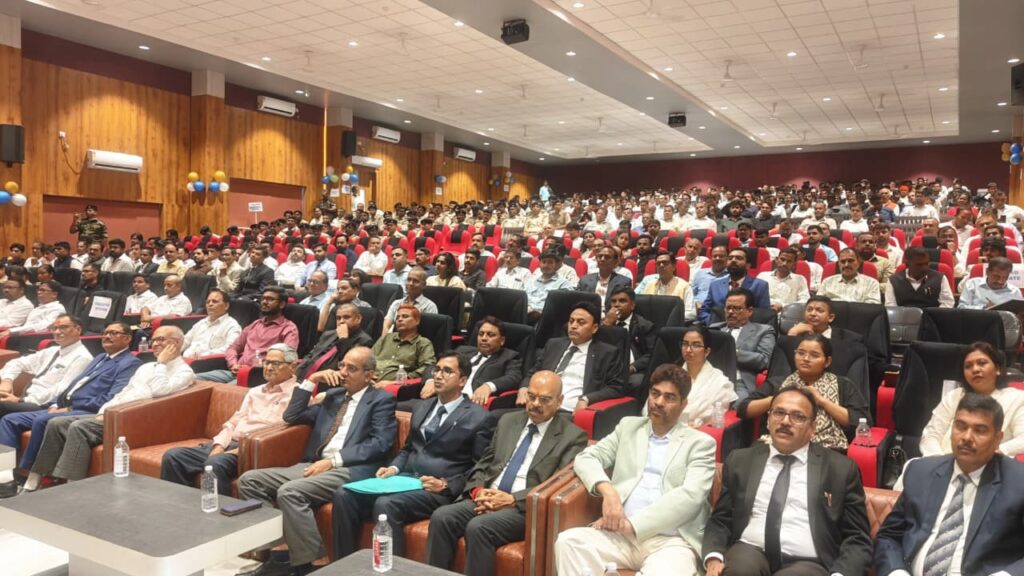
Chairman of Babu Dinesh Singh University Dinesh Singh, Vice-Chancellor N.K. Singh, judicial officers, administrative and police officials, faculty members and a large number of law students attended the programme.
The workshop ultimately sought to bridge the gap between classroom-based legal education and its practical application, while sensitising future lawyers to the wider dimensions of justice—from compensating victims of road accidents to protecting the rights and dignity of children.

.