In the age of Rama, when forests stretched beyond the horizon and the sea stood as a vast, uncharted frontier, there lay Lanka—the distant city of towers and ramparts, guarded by mountains and surrounded by water. Across that ocean went Hanuman, carrying hope in his heart and Rama’s purpose in his hands. Across it, too, marched the vanara host, determined to reach the city where Sita was held.
The story has travelled through centuries, carried by voices, manuscripts and memory. Yet one question continues to rise from its pages like a far-off shore: where was Lanka?
For many, the answer is Sri Lanka, the island south of India whose name and landscape have long been intertwined with the epic. The traditions of southern India, the sacred places near Rameswaram and the enduring memory of Ram Setu have strengthened this association across generations. In the imagination of countless readers and pilgrims, the waters between India and Sri Lanka are the very sea Hanuman crossed, and the island beyond them is Ravana’s Lanka.
But an epic is more than a map. In the Valmiki Ramayana, Lanka is described through the language of poetry and wonder. The Sundara Kanda and Yuddha Kanda speak of a fortified city, the mountains of Trikuta and Suvela, the immense sea and the extraordinary journey that led Hanuman to Sita. These images offer clues to place, yet they also belong to a world where the marvellous stands beside the physical, and where every landscape carries the weight of meaning.
To turn every description into a modern measurement is therefore not a simple task. The words must first be read in their own setting: in the language of the text, in the traditions of its telling and in the poetic scale of its events.
Among the most debated words is yojana, an ancient measure of distance used in accounts of Hanuman’s journey and his encounter with Surasa. Its value was not always the same in every text or age. If one yojana is taken as roughly 12 to 13 kilometres, a hundred yojanas would stretch for more than a thousand kilometres. The passage between Dhanushkodi and Talaimannar, by comparison, is about 25 to 30 kilometres.
The contrast is striking, but it cannot end the inquiry. Before a distance can become a conclusion, scholars must ask what measure the passage intends, how the word was used in that tradition and whether the poet is describing a literal span, an extraordinary trial or a journey enlarged by epic imagination.
The encounter with Surasa shows why that care matters. She opens her mouth wider and wider; Hanuman grows to meet the challenge. Then, with a sudden change of form and a sharper turn of wit, he becomes tiny, passes through and emerges free. The episode is not a traveller’s log. It is a moment of ingenuity and courage, a story in which strength is matched by intelligence. It tells us much about Hanuman—and cannot, by itself, tell us where Lanka stood.
There is another Lanka in the books of ancient Indian astronomers. In texts such as the Surya Siddhanta, Lanka appears as an idealised point on the equator, a reference used to calculate time, longitude and the movements of the heavens. This is the Lanka of mathematical astronomy, set within a system designed to understand the sky. Ravana’s Lanka belongs to the narrative landscape of the epic.
The names may be the same, but their purposes differ. One is a point in a scheme of calculation; the other is a city of story and memory. To join them requires evidence from the texts, not resemblance of name alone.
Across the years, the search for Lanka has wandered far beyond the familiar island. Some have looked to central India and Amarkantak; others have proposed islands in the southern seas or even Australia. The hills of Trikuta near Deoghar have also drawn attention because they bear a name found in the epic. Each suggestion opens a door, but none walks through it on a name alone.
A proposed location must answer to the whole account. Where are the mountains? How does the sea surround the city? Can the directions, journey and surrounding landscape be reconciled with the text? If Australia is proposed, what evidence places Trikuta and Suvela there? If Deoghar’s hills are linked to the epic, how do they fit the descriptions of a sea-ringed Lanka? These are not objections meant to close the search; they are the questions that make it a serious one.
Between India and Sri Lanka lies Ram Setu, also known as Adam’s Bridge: a chain of shallow marine formations whose geology and natural history continue to attract study. Science can examine the sediments, coral, rocks and changing waters. It can ask how the formations came to be and how old they are. To establish a direct link with an event in the Ramayana, however, requires more: reliable dating, archaeological evidence and a clear connection between the physical record and the text. The formation itself is a beginning for inquiry, not its final answer.
The manuscripts, too, carry the search forward. The Ramayana has been preserved in many regions, and its manuscripts do not always contain identical readings. A place-name, distance or description may vary from one tradition to another. Scholars must compare these readings, study the language and history of the manuscripts, and consider whether a passage belongs to an early layer of the text or was added later. In those variations may lie not only differences, but traces of how the epic travelled and took root in many communities.
The search for Lanka thus crosses several worlds: the world of poetry, the world of inherited belief, the world of ancient calculation and the world of material evidence. The traditional identification with Sri Lanka remains powerful and deeply woven into religious and cultural life. The astronomical Lanka belongs to a separate history of knowledge. Other proposed locations invite investigation, but must be tested against the text and supported by independent evidence.
No single verse, distance, name or natural formation can carry the whole weight of the answer. The strongest understanding will come when manuscript study, history, geography, archaeology and science speak to one another—and when each is allowed to show both what it can establish and what remains uncertain.
Perhaps Lanka endures because it is more than a destination. It is the far shore toward which Hanuman leapt, the stronghold Rama’s army sought, and the setting of a story that has crossed oceans of time. To ask where Lanka stood is to follow the epic’s wake: with reverence for its memory, curiosity about its landscapes and patience for the evidence still waiting to be read.
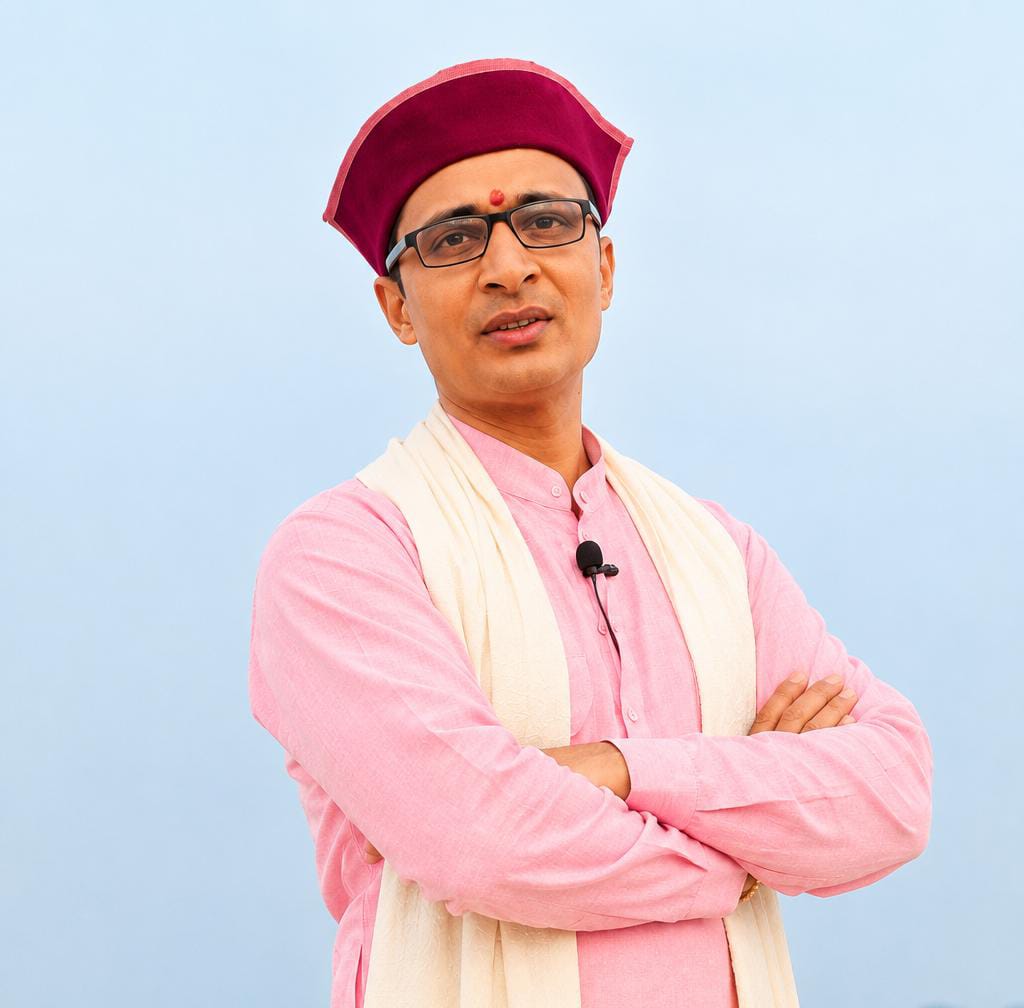
Arun Kumar Mishra, an acclaimed astrologer and author of Jyotish: Jeevan Path Ka Vigyan, brings the ancient science of Jyotish to life with remarkable clarity and depth. Drawing upon decades of learning and reflection, he illuminates the intricate connection between karma, destiny, and personal evolution. His writings encourage readers to look beyond forecasts and embrace astrology as a guiding light for self-awareness, wisdom, and a deeper understanding of life.