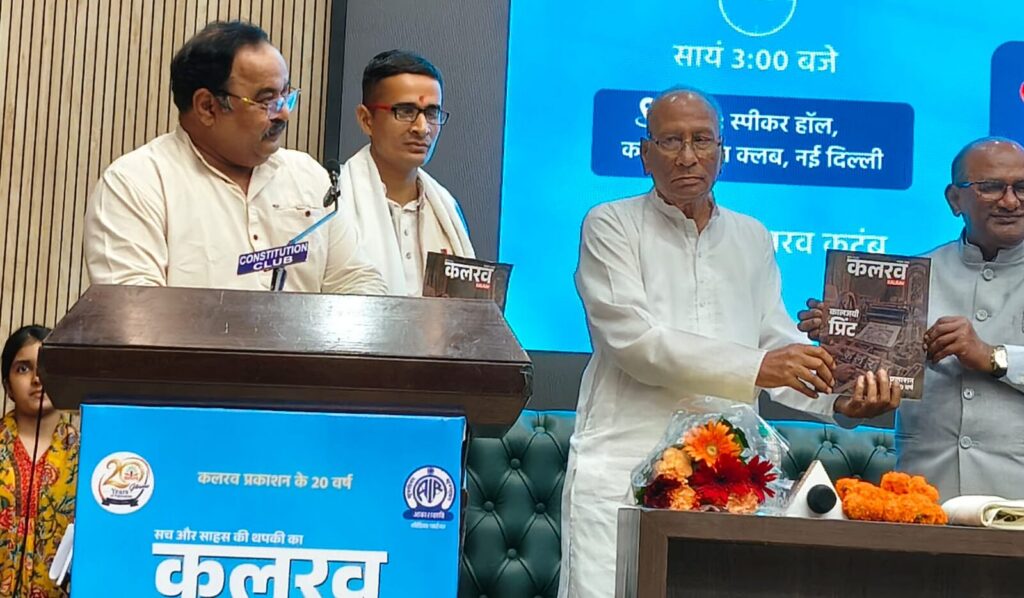
New Delhi: A literary gathering convened at Constitution Club to mark the launch of Jyotish: Jeevan Path Ka Vigyan, authored by astrologer Arun Kumar Mishra, evolved into a wider conversation on knowledge, publishing, the future of print media and the rapidly changing technological landscape, particularly the growing influence of Artificial Intelligence (AI) on society.
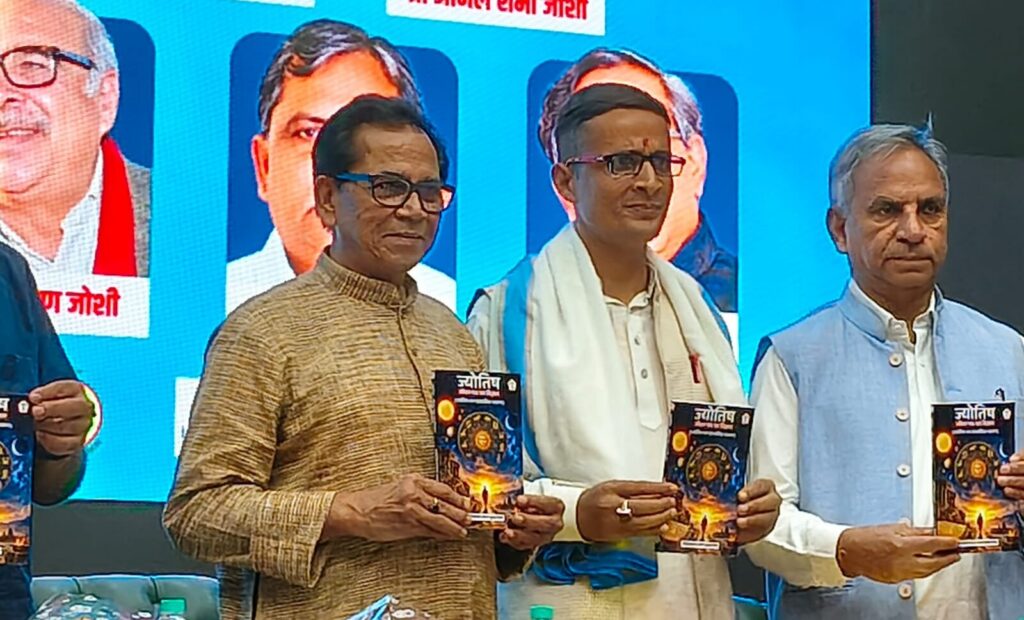
Published by Kalarav Prakashan, the book was unveiled in the presence of scholars, writers, academics, journalists, literary personalities and social workers. The occasion also marked a significant milestone for the publishing house as Kalarav Prakashan completed 20 years of its publishing journey, adding a distinct literary and institutional dimension to the programme.
The gathering brought together two important contemporary concerns alongside the central theme of the book: the economic sustainability of print media and the social implications of Artificial Intelligence. Prof. Alok Puranik and eminent poet, writer and literary figure Prof. Ashok Chakradhar used the occasion to draw attention to challenges that extend well beyond the realm of literature and publishing.
Twenty years of Kalarav Prakashan
The launch also became an occasion to reflect on the two-decade journey of Kalarav Prakashan. Speakers congratulated the publishing house on completing 20 years and described publishing as a sustained process of taking ideas to society, providing writers with platforms for expression and building relationships of trust with readers.
They expressed the hope that the publishing house would continue to encourage new writers, promote thought-oriented literature and help carry India’s knowledge traditions to younger generations.
The programme therefore acquired a significance extending beyond the formal launch of a book. It brought together the heritage of traditional knowledge, the contemporary crisis and opportunities of print media, and the emerging challenge of Artificial Intelligence—three distinct yet interconnected questions concerning how society creates, preserves, distributes and evaluates knowledge.
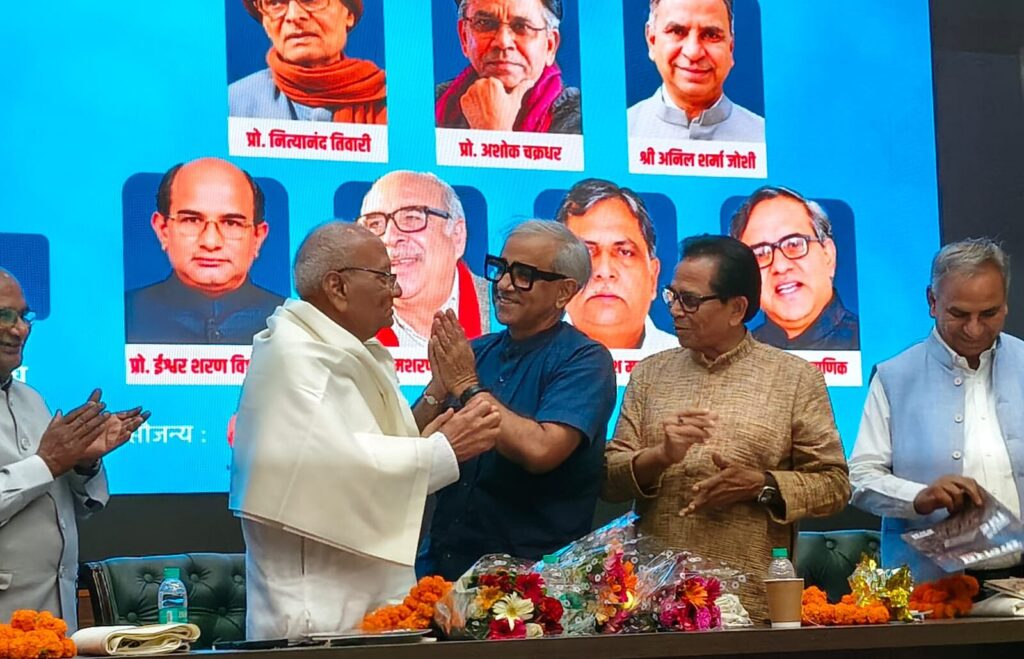
Among those present were Prof. Nityanand Tiwari, Prof. Ishwar Sharan Vishwakarma, Ramsharan Joshi, Anil Joshi, Prof. Rajesh Mall, Prof. Ashok Chakradhar and Prof. Alok Puranik. The programme also acknowledged the presence of Anuj K. Tiwari, founder and Editor-in-Chief of The Garhwa Post, senior Supreme Court advocate Vivek Kumar Mishra, writer and poet Swati Roy, Sarika Singh and Akash Srivastava, Chairman of NGO Constantanchy, among other invitees and well-wishers.
In his concluding remarks, Mishra said the central purpose of his work was to connect curiosity with study, faith with discernment, guidance with human effort and knowledge with human responsibility. He expressed the hope that the book would encourage readers to approach astrology with greater understanding and develop a more balanced perspective towards life’s challenges.
The New Delhi gathering thus became more than a book-release ceremony. It emerged as a forum where the endurance of traditional publishing, the economic future of print journalism, the social consequences of Artificial Intelligence and the continuing place of India’s knowledge traditions in contemporary life were brought into a common conversation—an exchange particularly appropriate for a publishing institution completing two decades of its literary journey.
Prof. Alok Puranik: Print media needs economic revival to sustain its future
Prof. Alok Puranik highlighted the increasingly complex environment confronting the print media and underlined that its survival cannot be viewed only from the standpoint of editorial commitment or public relevance. For print media to sustain itself as an important institution of democratic and intellectual life, he stressed the need to revive and strengthen its economic opportunities.
His intervention brought the discussion towards one of the fundamental questions confronting traditional journalism and publishing: how can the intellectual and social value of print be preserved while ensuring that newspapers and publishing institutions remain economically viable?
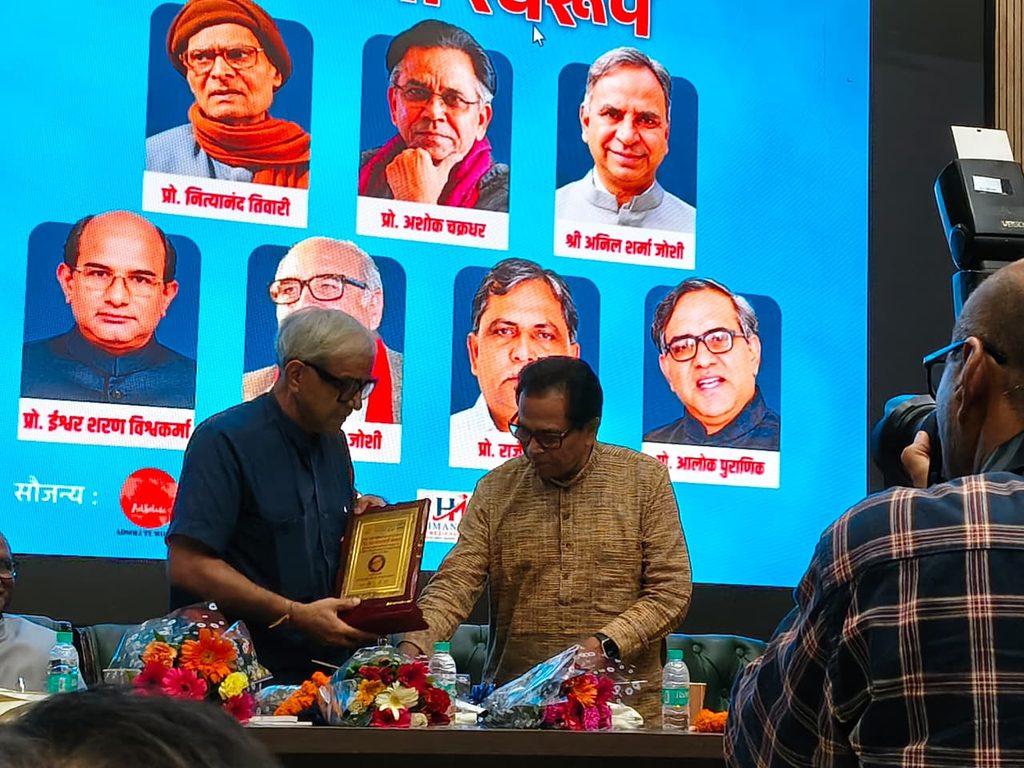
The changing media ecosystem has transformed the relationship between journalism, readers, advertisers and revenue. In such an environment, the future of print media, the discussion suggested, will depend not only on credibility and quality of content but also on its ability to identify sustainable economic opportunities and develop viable models capable of supporting independent editorial institutions.
Puranik’s observation consequently added an important dimension to the anniversary celebrations of Kalarav Prakashan. Twenty years of publishing, in this context, represented not merely an institutional milestone but also a reminder of the economic and organisational resilience required to keep ideas, books and print publications alive in an increasingly digital environment.
Prof. Ashok Chakradhar: Society must examine both the possibilities and limitations of AI
Prof. Ashok Chakradhar, one of the prominent literary voices associated with the programme, brought another contemporary concern to the forefront with his emphasis on Artificial Intelligence and its relationship with society.
Rather than approaching AI merely as a technological development, Chakradhar emphasised the importance of examining its wider social implications. The emergence of AI has opened new possibilities in communication, knowledge creation, research and information processing, but its expansion also raises questions concerning human creativity, judgement, originality, responsibility and the changing nature of work.
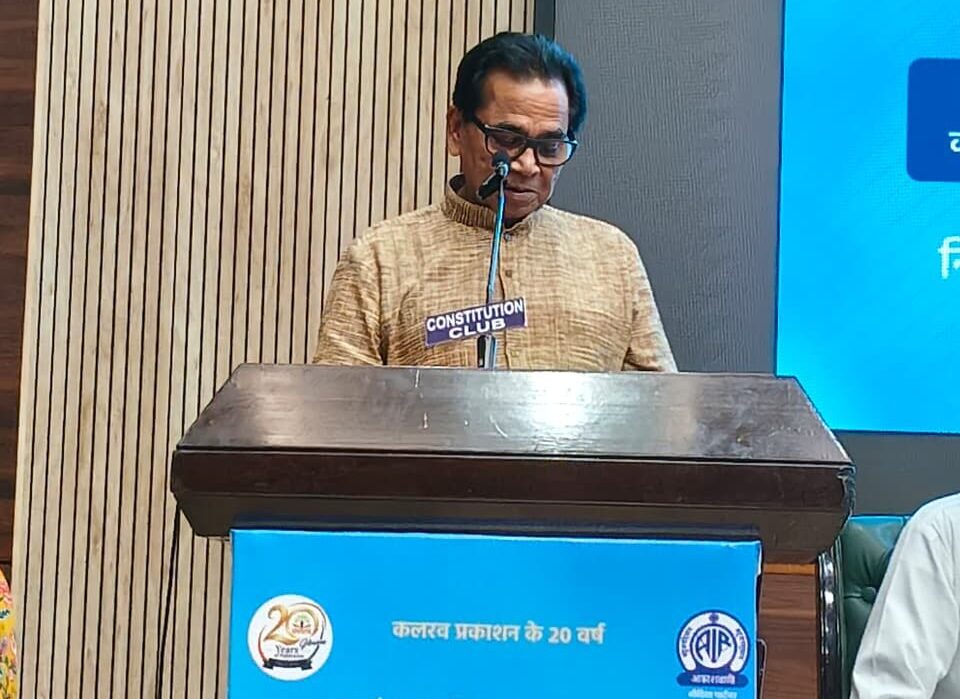
His intervention stressed the need to consider both the merits and demerits of AI, with society itself remaining central to the conversation. The question, therefore, is not simply what technology can accomplish, but how its growing capabilities should be integrated into human life without losing sight of social values, human judgement and responsibility.
The presence of this discussion at a literary event was particularly significant. Literature and publishing have traditionally been spaces where society examines its changing relationship with knowledge and technology. The conversation around AI consequently placed the 20-year publishing journey of Kalarav Prakashan against the backdrop of another profound transformation in the way knowledge is produced, distributed and consumed.
Book seeks to approach astrology through knowledge and discernment
Against this wider intellectual backdrop, Jyotish: Jeevan Path Ka Vigyan seeks to examine astrology through the broader framework of the Indian knowledge tradition, human experience, practical reasoning and philosophy of life.
In his address, author Arun Kumar Mishra said the book was conceived neither as an unquestioning endorsement of astrology nor as an outright dismissal of the subject without adequate study. Instead, he advocated an approach based on understanding its historical traditions, principles, practical dimensions and limitations.
The book, according to Mishra, attempts to move beyond viewing astrology exclusively as a means of predicting the future or prescribing rituals. Its broader objective is to encourage readers to examine the subject with curiosity while retaining intellectual openness and a sense of responsibility towards life.
The volume comprises 100 chapters divided into four sections. The first, “The Real Nature of Astrology,” examines its basic concepts, character and knowledge tradition. The second, “Life’s Problems and Astrology,” considers different circumstances of human life and the manner in which astrological perspectives are applied to them. The third, “Astrological Remedies and the Practical Dimension,” examines remedies and their practical application, while the fourth, “Astrology and the Philosophy of Life,” explores broader questions of human thought and life philosophy.
A significant philosophical proposition in the author’s presentation was that astrology should not become a substitute for human effort. Referring to the Bhagavad Gita and the principle of “Karmanye Vadhikaraste,” Mishra emphasised the importance of action, duty and personal responsibility.
He also argued that astrological counselling should carry an ethical responsibility. Where mathematical or astronomical facts are available, they should be presented clearly; traditional beliefs should be identified in their appropriate context; and where certainty cannot be established, excessive or definitive claims should be avoided.
The book thus places faith and reason, tradition and inquiry, guidance and human effort within the same intellectual framework. Mishra maintained that genuine respect for Indian knowledge traditions requires study, questioning, engagement with foundational texts and responsible contemporary reflection.