In Palamu’s municipal amphitheatre, Aruna Shankar has been both origin and recurrence—first mayor and later the listed incumbent of Medininagar Municipal Corporation—her name etched on the district’s Urban Local Body roll even as the city’s governance remains a moving target. Her political scaffolding is unmistakable: the BJP publicly backed her in the current municipal cycle; she filed nomination for another run; and earlier, LJP leaders shared platforms with BJP functionaries to amplify her candidature—coalitions that lend administrative leverage, even as they tint the office with partisan hue.
The marrow of her record sits on land. On January 8, 2024, mayor Aruna Shankar wrote to the Chief Minister alleging a sprawling racket in Hamidganj–Kund and adjoining belts: government plots parcelled by intermediaries, families stranded without registries or local certificates, and even a burial ground’s disappearance amid illicit sale of water, sand, and riverine assets. Her prescription was unambiguous—state‑run settlement camps to issue receipts (i.e., formalize tenure) and refunds of money taken by touts—an insistence on regularization plus restitution rather than bulldozers masquerading as policy.
Frontline enforcement has likewise exposed the distance between doctrine and method. In December 2024, MMC demolished a portion of a temple boundary wall as “encroachment,” then rebuilt it within 24 hours amid protests, while the city commissioner promised an inquiry into compliance with the Jharkhand Public Land Encroachment (Amendment) Act, 2016)—a parable of why codified SOPs (notice, hearing, rehabilitation) must precede a single brick.
No crucible is more revealing than khas‑mahal, the colonial leasehold that cages Medininagar’s title economy. In October 2022, a DC‑chaired Advisory Committee doubled renewal rates inside the corporation area, triggering a public face‑off in which Shankar opposed the hike and hinted at court—evidence that the pricing valve sits with the district apparatus rather than the mayor alone. A year later, the administration clarified the hinge that could rationalize costs: Deputy Commissioners are the competent authority for minimum (circle) value fixation; where valuations overshoot reality, a DC‑led multi‑officer committee (Additional Collector, Land Reforms SDO, Sub‑Registrar, municipal executives, and Building Construction engineer) can review and revise ward, mauja‑wise rates and notify the IG Registration—a precondition to make renewals financially sane.
Even so, the pipeline seized again. After a state‑level 10% hike in July 2025, local tallies say not a single lease renewed in Medininagar; the city has 1,893 leaseholders, only 53 “live” leases, and 1,840 pending, while per‑decimal rates escalated (e.g., residential main road 6,21,650 vs 5,65,130 earlier; commercial main road 12,43,290 vs 11,30,260). The choke points were structural: annual salami (2% residential and 5% commercial) compounded by 10% penalty on total salami for delays—arithmetic that turns renewal into a fiscal fiction for ordinary holders.
By September 2025, Ranchi appeared to blink. Multiple reports outlined a prospective rate surgery—0.5% (residential) and 2.5% (commercial) renewal burdens with nominal trespasser charges—framed against the fact that Medininagar hosts the highest concentration of khas‑mahal leaseholders (1,895 lessees over 1,600 acres). In parallel, a May 2025 high‑level meeting chaired by the Finance Minister explored lowering salami, making lease land mortgageable, permitting multi‑storey construction, and standardizing renewal, transfer, change‑of‑use, while tempering annual ground rent (lagan)—an agenda pitched as affordability and revenue, not a zero‑sum.
The statewide scale exposes the structural bind. Jharkhand’s khas‑mahal estate spans 58,751 hectares across 10,518 leaseholders (9,562 residential), yet by mid‑2025 only 700 applications for renewal had been filed—a statistic that indicts cost, opacity, and procedural drag beyond Medininagar. In that macro, Shankar’s own interventions—urging her party to codify time‑bound renewals “as per agreement” and reminding that much of Medininagar has been unrenewed for 30 years—read less as rhetoric and more as pressure on the legal‑administrative spine.
Policy without process is theatre. A divisional revenue review demanded time‑bound disposal of mutation cases (older than 90 days) and clearing of land‑acquisition bottlenecks (including NH‑75, NH‑98 and coal corridors), because settlement camps cannot cure title if the revenue pipeline is blocked. The corporation’s own portals show tenders—including a “digital map” EOI in May 2023—breadcrumbs toward a GIS‑backed cadastre and cleaner taxation if carried through; yet there remains no ward‑wise renewal dashboard, no public ledger of leases renewed, rates applied, or arrears resettled.
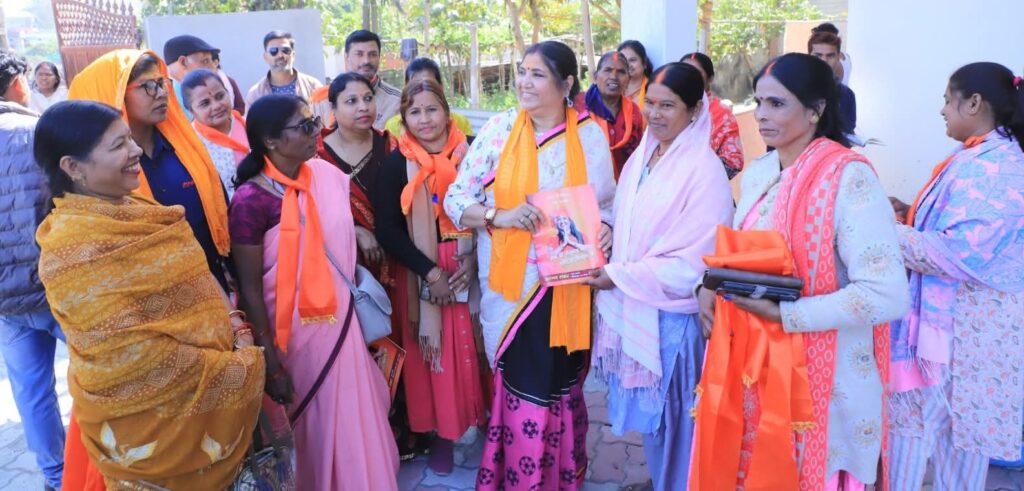
Soft power has been Shankar’s accessible instrument. She has fronted plantation drives along the Mandhata riverbank, braiding ecology with civic remembrance; conversely, the 65‑lakhs “green zone” on Mahila College Road drew criticism for removing a tubewell during a water‑starved summer and planting edges 1.5 feet from the carriageway—design choices the city defended but that raise planning diligence questions. If Medininagar seeks an immediate template for transparency, Hazaribag’s district pages already publish renewed‑lease lists (up to 2038) and holding‑wise details—exactly the kind of disclosure that turns rumour into audit.
The file shows a mayor who named land‑market malfeasance with granular specificity and argued a regularization‑with‑restitution doctrine rare in municipal politics; a state apparatus that both tightened the fiscal screw (2025 hike) and then signalled relief (proposed 0.5%/2.5% rates), while exploring structural changes to make leases livable and bankable; and a city that has flirted with digitization without delivering the public, ward‑wise renewal ledger that would prove progress. Until Medininagar publishes that live table—leases renewed, rates applied, arrears resettled, families formalized—its land story will remain suspended between a reformist pitch and the measurable silences that only data can end.